
Logistics is one of the most important parts of modern business. Every time a product moves from a factory to a warehouse, from a port to a distribution center, or from a store to a customer’s doorstep, logistics is at work behind the scenes.
However, the logistics and shipping industry is filled with technical language that can feel overwhelming at first. For business owners, beginners, or anyone new to the industry, understanding common logistics terms and concepts can be confusing.
That’s why learning the most common logistics terms is so important. When you clearly understand key concepts like freight, 3PL, Bill of Lading, FCL vs. LCL, lead time, and last-mile delivery, you can reduce shipping errors, avoid costly delays, manage expenses better, and communicate more effectively with carriers and logistics providers.
This guide is created for anyone who wants to better understand how shipping and delivery systems work in real-world business scenarios.
Whether you’re managing orders, handling suppliers, or coordinating deliveries, having a clear understanding of common logistics concepts can make your work much easier and more efficient.
This guide is especially helpful for:
What You’ll Learn in This Guide
In this article, we break down 20 essential logistics terms that are widely used across transportation, warehousing, freight management, and delivery operations.
Each term is explained in a simple and practical way, along with real-world examples to help you understand how things work in actual business scenarios.
By the end of this guide, you will:
Let’s break down the 20 most important logistics terms you should know:
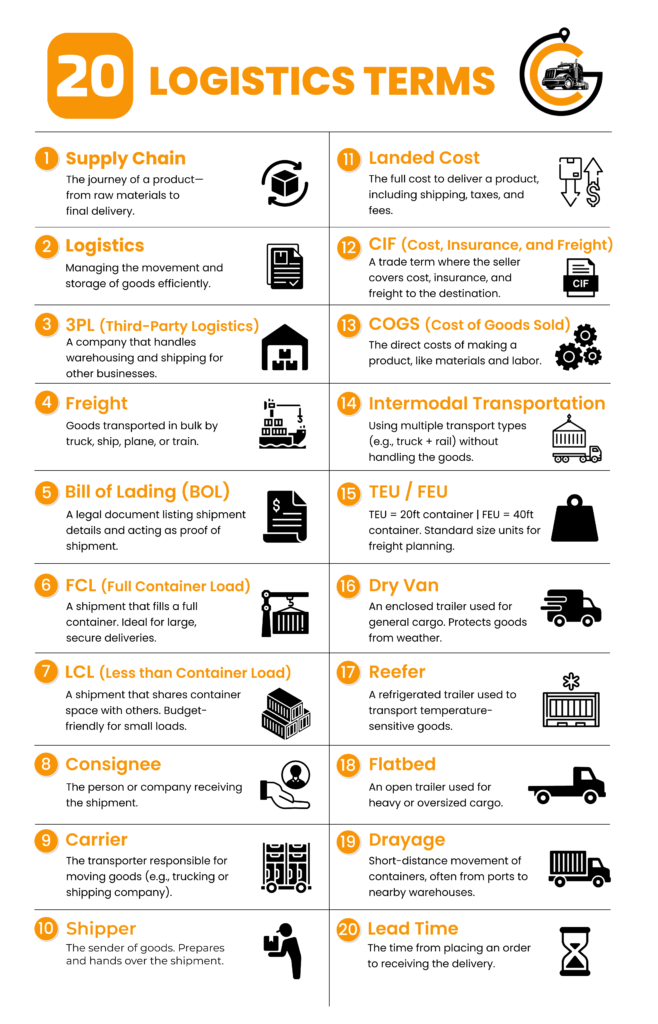
The supply chain refers to the complete end-to-end process involved in producing and delivering a product to the final customer. It includes multiple stages such as sourcing raw materials, manufacturing, warehousing, transportation, and final delivery.
A well-managed supply chain ensures that products move efficiently between each stage, helping businesses reduce delays, control costs, and meet customer expectations. Even a small disruption in one part of the chain can impact the entire process, which is why businesses invest heavily in optimizing their supply chain operations.
For companies operating in the U.S., where products often move across multiple states, having a strong supply chain strategy is essential for maintaining timely deliveries and staying competitive.
Example: A skincare brand based in California sources ingredients from suppliers in Texas, manufactures products in Los Angeles, stores inventory in a Nevada warehouse, and delivers orders to customers across the U.S. This entire journey — from sourcing to delivery — is known as the supply chain.
Logistics is a key component of the supply chain that focuses specifically on the movement, storage, and handling of goods. It involves activities such as transportation, warehousing, inventory management, packaging, and order fulfillment.
The primary goal of logistics is to ensure that products are delivered to the right place, at the right time, and in the most cost-effective way. Efficient logistics operations help businesses avoid delays, reduce shipping costs, and improve customer satisfaction.
In the U.S., where fast shipping and reliable delivery are major customer expectations, strong logistics systems play a crucial role in business success.
Example: When a customer places an order on an online store, the logistics process includes picking the item from a warehouse, packing it securely, and shipping it through carriers like UPS or FedEx for delivery to the customer’s home.
A Third-Party Logistics (3PL) provider is a company that manages logistics operations on behalf of another business. These services typically include warehousing, inventory management, order fulfillment, and shipping.
Using a 3PL allows businesses to outsource their logistics processes instead of handling them in-house. This can save time, reduce operational costs, and provide access to advanced logistics infrastructure without heavy investment.
For growing eCommerce businesses in the U.S., partnering with a 3PL is often a strategic decision to scale operations efficiently while focusing on marketing and sales.
Example: A small online brand selling products nationwide uses Amazon FBA. Amazon stores the products in its fulfillment centers, packs customer orders, and handles shipping and returns — effectively acting as the company’s 3PL partner.
Freight refers to goods that are transported in large quantities for commercial purposes. Unlike small parcel shipments, freight typically involves bulk goods moved via trucks, rail, air, or ocean carriers.
Freight transportation is a critical part of business operations, especially for manufacturers, wholesalers, and distributors who need to move large volumes of products efficiently across long distances.
In the U.S., freight is commonly moved through trucking networks that connect major cities and distribution hubs, making it a backbone of the national supply chain.
Example: A company ships 1,000 units of electronic products from a warehouse in Chicago to a retail distribution center in New York using a full truckload shipment. This type of bulk shipment is considered freight.
A Bill of Lading (BOL) is an essential shipping document that serves as a contract between the shipper and the carrier. It contains important details such as the type of goods, quantity, destination, and the parties involved in the shipment.
The BOL plays multiple roles — it acts as a receipt confirming that goods have been handed over for transport, a legal contract outlining shipping terms, and a document used for tracking and verification.
In logistics operations, especially in the U.S., the Bill of Lading is critical for ensuring transparency and accountability throughout the shipping process.
Example: A supplier in Texas ships a batch of goods to a retailer in Florida. The Bill of Lading includes shipment details, delivery address, and carrier information, ensuring both parties have clear documentation in case of delays, damage, or disputes.
FCL and LCL are shipping methods used in ocean freight to transport goods in containers.
Choosing between FCL and LCL depends on shipment size, budget, and delivery urgency. If you’re new to container shipping, understanding the different types of shipping containers can also help you choose the right option for your business.
Example: A U.S.-based furniture importer orders a large shipment from overseas that fills an entire container — they choose FCL for faster delivery and reduced handling. On the other hand, a small business importing limited inventory shares container space using LCL to save costs.
The consignee is the individual or business that receives the shipment at its final destination. Their details are listed on shipping documents to ensure accurate delivery.
The consignee is responsible for accepting the goods, verifying their condition, and signing off upon delivery. In many cases, they are also responsible for handling any import duties or documentation if the shipment is international.
Example: A retailer in New York orders products from a supplier. When the shipment arrives, the retailer is listed as the consignee and receives the goods at their warehouse.
A carrier is the company or service provider responsible for transporting goods from one location to another. Carriers can operate through different modes of transport, including trucking, air freight, rail, or ocean shipping.
Carriers play a critical role in logistics by ensuring that shipments are delivered safely and on time. Businesses often choose carriers based on cost, reliability, and delivery speed.
Example: A company ships products from California to Texas using a trucking company. In this case, the trucking company acts as the carrier responsible for delivering the goods.
The shipper is the person or business that sends the goods. They are responsible for preparing the shipment, packaging it properly, and providing all necessary documentation before handing it over to the carrier.
The shipper ensures that the goods are ready for transport and that all details — such as addresses, labels, and shipment contents — are accurate to avoid delays or issues during transit.
Example: A manufacturer in Ohio sends products to a distribution center in Florida. The manufacturer is the shipper, as they are responsible for dispatching the goods.
Landed cost refers to the total cost of getting a product from the supplier to its final destination. It includes not only the product price but also shipping fees, insurance, customs duties, taxes, and handling charges.
Understanding landed cost is essential for businesses because it helps determine the true cost of a product and ensures accurate pricing and profitability.
For U.S. businesses involved in importing goods, calculating landed cost correctly can prevent unexpected expenses and protect profit margins.
Example: A business imports products from overseas. While the product itself costs $10 per unit, additional expenses such as shipping, customs duties, and delivery increase the total cost to $15 per unit — this final amount is the landed cost.
CIF (Cost, Insurance, and Freight) is an international shipping agreement where the seller is responsible for covering the cost of goods, shipping charges, and insurance until the shipment reaches the destination port.
Once the goods arrive at the port, the buyer takes responsibility for customs clearance, duties, and final delivery. CIF is commonly used in global trade because it simplifies the shipping process for buyers.
Example: A U.S. importer purchases goods from a supplier in China under CIF terms. The supplier pays for shipping and insurance up to the Port of Los Angeles. After arrival, the importer handles customs clearance and transportation to their warehouse.
COGS (Cost of Goods Sold) refers to the direct costs involved in producing or purchasing a product. This includes expenses such as raw materials, manufacturing, and labor.
COGS does not include indirect costs like marketing or shipping. Understanding COGS is important for businesses to calculate profit margins and set competitive pricing.
Example: A U.S.-based apparel brand spends money on fabric, stitching, and labor to produce a t-shirt. These direct costs make up the COGS, which helps the business determine how much profit they make on each sale.
Intermodal transportation involves moving goods using two or more different modes of transport such as trucks, rail, and ships without handling the cargo itself when switching between modes.
This method improves efficiency, reduces costs, and minimizes the risk of damage since the goods remain in the same container throughout the journey.
Example: A shipment travels from Los Angeles to Chicago by train and is then delivered locally by truck to a warehouse. Since the goods stay in the same container throughout the journey, this is considered intermodal transportation.
TEU and FEU are standard units used to measure shipping container capacity.
These measurements are widely used in global shipping to calculate space, plan shipments, and estimate costs.
Example: A U.S. importer books space for two FEU containers to transport goods from overseas. This means they are shipping the equivalent of four 20-foot containers worth of cargo.
A dry van is a standard enclosed trailer used in trucking to transport general cargo. It protects goods from weather conditions such as rain, dust, and sunlight, making it one of the most commonly used transportation methods in the U.S.
Dry vans are ideal for transporting packaged goods that are often loaded on pallets for easy handling and storage. Understanding standard pallet size dimensions can help businesses optimize space and reduce shipping costs.
Example: A company ships packaged electronics from a warehouse in Texas to a retail store in Arizona using a dry van truck, ensuring the goods remain protected during transit.
A reefer (short for refrigerated trailer or container) is used to transport temperature-sensitive goods that need to be kept within a specific temperature range during transit.
These are commonly used for perishable items such as food, pharmaceuticals, and flowers. Maintaining the correct temperature is critical to prevent spoilage, damage, or loss of product quality.
Example: A food distribution company transports frozen products from a warehouse in California to grocery stores across the U.S. using reefer trucks to keep the goods at the required temperature throughout the journey.
A flatbed truck is an open trailer without sides or a roof, designed to carry oversized, heavy, or irregularly shaped cargo that cannot fit inside standard enclosed trailers.
Flatbeds allow easy loading and unloading from the sides or top, making them ideal for construction materials, machinery, and large equipment.
Example: A construction company ships large steel beams from a supplier in Pennsylvania to a job site in New Jersey using a flatbed truck, as the cargo cannot be enclosed in a standard trailer.
Drayage refers to the short-distance transportation of goods, typically between ports, rail yards, and nearby warehouses or distribution centers.
Although it covers a short distance, drayage is a critical step in the overall shipping process, especially in international logistics where goods need to be moved quickly after arriving at a port.
Example: After a container arrives at the Port of Los Angeles, it is transported by truck to a nearby warehouse for storage. This short trip is known as drayage.
Lead time is the total time it takes from placing an order to receiving the final product. It includes processing, production, shipping, and delivery time.
Understanding lead time helps businesses plan inventory, avoid stockouts, and ensure timely fulfillment of customer orders.
Example: A retailer orders inventory from a supplier, and it takes 10 days to manufacture, 5 days to ship, and 2 days to deliver. The total lead time for this order is 17 days.
Last-mile delivery is the final stage of the shipping process, where goods are transported from a distribution center or local hub to the customer’s doorstep.
This stage is often the most time-sensitive and costly part of logistics, as it directly impacts customer satisfaction and delivery experience.
Example: A package shipped through a major carrier reaches a local delivery center in Chicago and is then delivered to the customer’s home the same day. This final step is known as last-mile delivery.
Many people use logistics and supply chain interchangeably, but they are not the same.
In simple terms, logistics is a part of the supply chain.
Understanding the difference is important for businesses, especially in the U.S., where efficient operations and fast delivery play a major role in customer satisfaction and profitability.
| Basis | Logistics | Supply Chain |
| Definition | Focuses on movement, storage, and delivery of goods | Covers the entire process from production to final delivery |
| Scope | Narrow (part of the process) | Broad (end-to-end system) |
| Main Focus | Transportation, warehousing, and distribution | Sourcing, production, logistics, and delivery |
| Key Activities | Shipping, inventory storage, order fulfillment | Procurement, manufacturing, logistics, demand planning |
| Goal | Deliver goods efficiently and on time | Optimize the entire flow of goods and reduce overall costs |
| Involvement | Operational level | Strategic + operational level |
| Example | Delivering products from warehouse to customer | Managing suppliers, production, storage, and final delivery |
A U.S.-based company selling home products:
While the 20 terms above cover the core concepts, there are several other important logistics terms that are commonly used in day-to-day operations. Understanding these will give you a more complete picture of how shipping, warehousing, and delivery systems work.
Inventory management is the process of tracking, storing, and controlling stock levels to ensure products are available when needed without overstocking.
Example: A warehouse in Texas uses software to monitor stock levels and automatically reorder products when inventory runs low.
Order fulfillment refers to the entire process of receiving, processing, packing, and shipping customer orders.
Example: When a customer places an order online, the warehouse picks the item, packs it, and ships it through a carrier — this entire process is order fulfillment.
Reverse logistics involves handling returned products from customers back to the seller or warehouse. It includes returns, repairs, recycling, or disposal.
Example: A customer returns a damaged product, and the company processes the return, inspects the item, and issues a refund or replacement.
A freight forwarder is a company that arranges shipments on behalf of businesses. They coordinate transportation, documentation, and customs clearance.
Example: A U.S. importer hires a freight forwarder to manage shipping goods from overseas and handle all required paperwork.
A distribution center is a warehouse facility designed for storing and quickly distributing products to retailers or customers.
Example: A company stores products in a distribution center in New Jersey to enable faster delivery across the East Coast.
To help you better understand the logistics industry, here are some of the most frequently asked questions people search on Google. These answers cover common shipping terms, freight concepts, and key logistics frameworks to make supply chain operations easier to understand.
Supply chain management is the process of overseeing the entire journey of a product from raw materials to the customer. It involves suppliers, production, warehousing, transportation, and delivery. The goal is to improve efficiency, reduce delays, and keep costs low.
The most common logistics terms include supply chain, freight, 3PL, carrier, consignee, Bill of Lading, lead time, and last-mile delivery. These terms are used daily in shipping, warehousing, and transportation operations.
Logistics terminology is important because it improves communication between shippers, carriers, and warehouses. Understanding key terms helps businesses avoid costly mistakes, reduce delays, and manage supply chains efficiently.
Freight refers to goods transported in bulk through commercial transportation methods such as trucks, ships, trains, or airplanes. Freight usually involves large shipments for business or industrial purposes.
A 3PL company provides outsourced logistics services such as warehousing, inventory management, order fulfillment, and shipping. Businesses use 3PL providers to save time, reduce costs, and scale operations faster.
The shipper is the person or company sending goods, while the carrier is the transportation provider responsible for delivering those goods safely to the destination.
A Bill of Lading serves as a legal contract and receipt for shipped goods. It confirms shipment details, protects both parties, and is used for tracking and claims in case of loss or damage.
FCL is best when you have large shipments that can fill a container. It offers faster delivery, better security, and fewer handling risks compared to LCL, which is used for smaller shipments.
Intermodal transportation means moving goods using multiple transport modes, such as truck, rail, and ship, without unloading the cargo. It reduces costs and improves shipping efficiency.
TEU and FEU are container measurement units used in international shipping. TEU represents a 20-foot container, while FEU represents a 40-foot container. They help calculate shipping space and freight costs.
A reefer truck is used to transport temperature-sensitive products such as frozen foods, pharmaceuticals, dairy, and flowers. It prevents spoilage by maintaining controlled temperatures.
Last-mile delivery refers to the final stage of shipping, where goods move from a distribution center to the customer’s doorstep. It is often the most expensive and time-sensitive part of logistics.
Drayage is the short-distance movement of freight, usually between ports, rail terminals, and warehouses. It plays a key role in connecting ocean freight with inland transportation.
Landed cost is calculated by adding the product price, shipping fees, insurance, customs duties, taxes, and handling charges. It helps businesses understand the true total cost of imported goods.
Dry vans are enclosed trailers used for general cargo, while flatbeds are open trailers used for oversized or heavy freight like machinery, steel, or construction materials.
The main logistics services include transportation, warehousing, inventory management, freight forwarding, packaging, and last-mile delivery. Many companies outsource these services to 3PL providers.
Supply chain covers the entire process from sourcing raw materials to delivering the final product. Logistics is one part of the supply chain that focuses specifically on transportation, storage, and distribution.
CIF stands for Cost, Insurance, and Freight. It means the seller pays for shipping and insurance until the goods reach the destination port, while the buyer handles customs duties and final delivery.
The 7 R’s of logistics describe the key goal of logistics operations: delivering the right product, in the right quantity, in the right condition, at the right place, at the right time, to the right customer, and at the right cost. These principles help ensure efficient and customer-focused supply chain management.
The 5 P’s of logistics refer to the essential areas that logistics planning focuses on: Product, Place, Price, People, and Process. Together, they help businesses manage transportation, warehousing, distribution, and customer satisfaction effectively.
The 12 key elements of logistics include major functions involved in moving goods through the supply chain:
These elements work together to improve efficiency and reduce delivery delays.
The 4 pillars of logistics are the core areas that support successful logistics operations:
Strong performance in these pillars helps businesses reduce costs and improve delivery reliability.

Comments are closed