
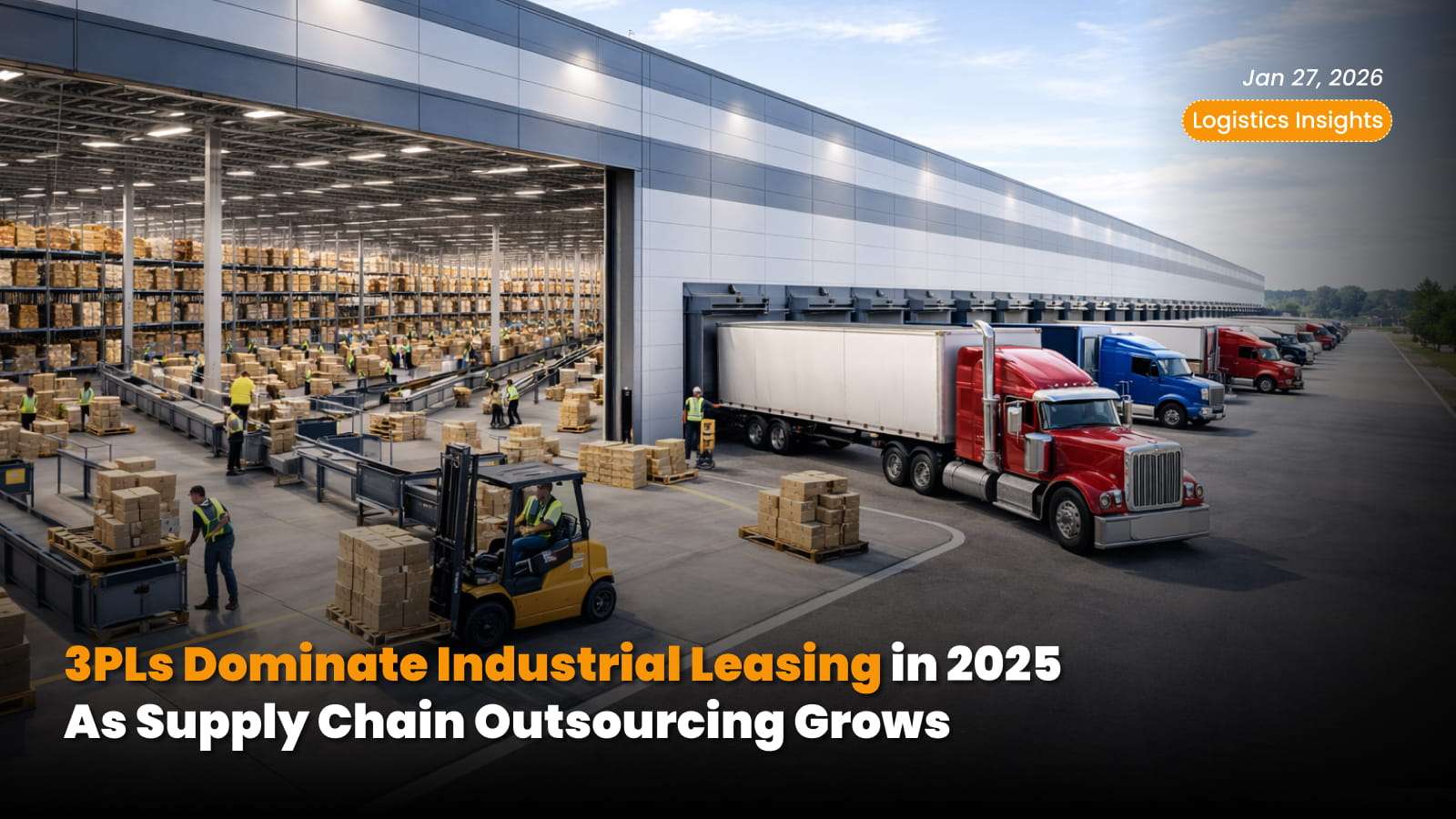
Third-party logistics providers (3PLs) became the top drivers of major industrial lease activity in 2025, reflecting a growing trend of companies outsourcing supply chain operations.
A new report from CBRE shows that 3PL companies signed 44 of the 100 largest industrial leases last year. That is a sharp rise from 28 leases in 2024, representing a 57% increase year over year.
CBRE explained that more corporations are turning to logistics partners to manage complex distribution needs, especially with continued growth in e-commerce.
Retailers and wholesalers made up the second-largest share of the biggest lease deals, but their numbers declined compared to the prior year.
That group completed 28 major leases in 2025, which was 10 fewer than in 2024.
The automotive industry was the only other sector to see an increase, moving from five leases in 2024 to seven leases in 2025.
CBRE noted that industrial tenants are increasingly upgrading their facilities and signing bigger leases to support long-term supply chain goals.
As John Morris, president of Americas Industrial & Logistics at CBRE, stated:
“Occupiers committed to larger footprints and longer lease terms as they took advantage of opportunities to upgrade their space amid a continued flight to quality trend,” said John Morris, president of Americas Industrial & Logistics at CBRE. “2025’s activity reflects continued strong demand for large distribution facilities as occupiers prioritize scale, efficiency, and long-term supply chain solutions.”
The total square footage covered by the top 100 leases reached 98.8 million square feet in 2025, increasing by about 2 million square feet compared to the previous year.
New leases represented the majority of the activity:
This shows that many occupiers are moving into newer, higher-quality warehouse facilities.
Certain logistics hubs saw the most major leasing activity in 2025, including:
CBRE found that both lease sizes and lease terms grew slightly last year:
The report also explained the shift toward longer-term agreements:
“The increase in lease terms is due to the stabilization of supply and rent growth,” the CBRE (NYSE: CBRE) report said. “As a result, landlords are now more focused on maintaining occupancy and securing tenants for longer periods. Some landlords are offering incentives to lock in occupancy and reduce turnover risk.”
Warehouse leader Prologis recently shared optimism about improving industrial conditions.
The company noted that vacancies have peaked, and rental rates are beginning to rise again in some markets.
Prologis expects net absorption to grow to 200 million square feet in 2026, while new warehouse deliveries decline, helping vacancy rates fall toward 7.1%–7.2%.
The company also reported record leasing activity in 2025, with e-commerce responsible for 20% of new deals.
The 2025 industrial real estate market highlights a clear shift: as more companies outsource logistics, 3PL providers are taking a dominant role in leasing large distribution facilities, helping shape the future of supply chain infrastructure across the U.S.



Comments are closed