
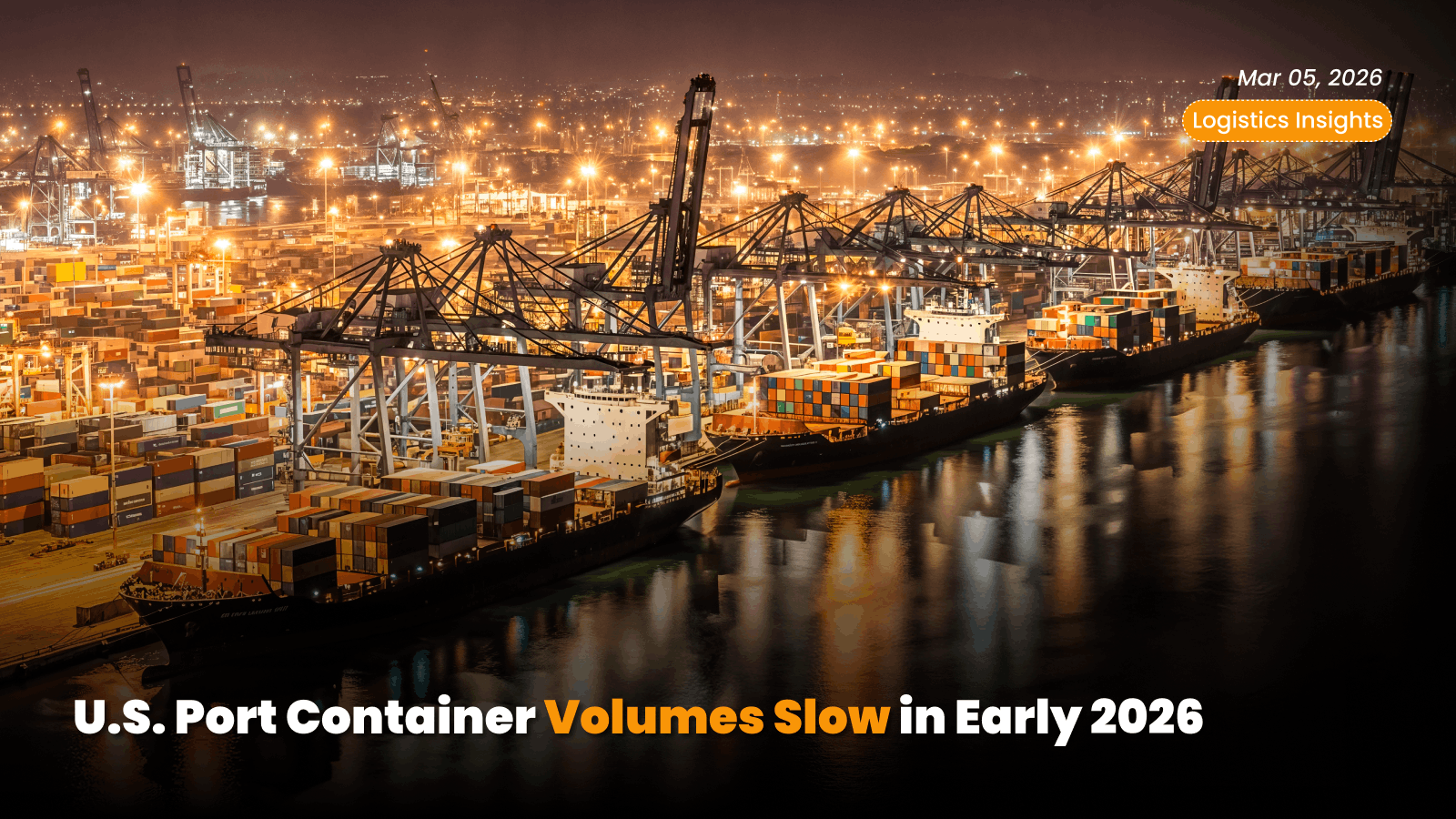
Container traffic across major U.S. ports showed a slower start to 2026, following an unusually strong shipping year in 2025. The drop in January volumes was largely expected as many businesses had accelerated shipments late last year to get ahead of possible tariff increases.
This earlier surge in cargo movement, combined with cautious inventory management and ongoing trade uncertainty, contributed to lower year-over-year volumes at several key ports.
While some ports experienced declines compared with last year’s unusually high numbers, others reported stable or slightly increased activity.
The Port of Los Angeles handled 812,000 twenty-foot equivalent units (TEUs) in January, compared to 924,245 TEUs during the same month in 2025, marking a 12% decrease.
The port had a strong performance in 2025, recording its third-busiest year ever, but cargo momentum slowed toward the end of the year.
“There are several factors at play,” Port of Los Angeles Executive Director Gene Seroka said during a media briefing. “First, we’re comparing January to 2025 elevated numbers when importers were scrambling to get cargo in ahead of tariffs. Second, inventories remain slightly higher, reflecting the earlier cargo surge and a more cautious restocking pace.”
Seroka also noted that uncertainty around trade policy and consumer demand continues to affect future forecasts, although purchase orders heading to Asia have remained relatively stable heading into the spring season.
The Port of Long Beach reported 847,765 containers moved in January, which was 11% lower than the 952,733 containers recorded during the same period last year.
Despite the year-over-year drop, it was still the second-busiest January in the port’s history, following a record year driven by tariff concerns and supply chain uncertainty.
“No matter what happens with cargo volume, the Port of Long Beach has the capacity, infrastructure and workforce to move goods quickly, efficiently and reliably,” Port of Long Beach CEO Noel Hacegaba said during the first of his monthly supply chain insight media briefings.
Trade policies and tariffs continue to influence shipping decisions. President Donald Trump has used tariffs extensively as part of efforts to reshape international trade policies. A recent 6-3 decision by the U.S. Supreme Court ruled against the use of the International Emergency Economic Powers Act for certain tariff actions.
“While this decision ruled on the legality of the IEEPA tariffs, it did little to remove the uncertainty we’ve seen — and continue to see — across the global supply chain,” Hacegaba said. “Our customers are seeking clarity on whether tariffs already paid will be refunded, and consumers are seeking relief from higher prices.”
The Port of Oakland reported 195,897 containers in January, a 1.4% increase from 193,175 containers during the same period in 2025.
The modest growth indicates a stable start to the year, supported mainly by stronger import activity following the holiday shipping season.
“Oakland continues to deliver the reliability and efficiency that importers and exporters depend on as supply chains adjust to changing market conditions, including maintaining cargo flows during severe winter weather, supported by increased rail volumes overall, including through inland hubs such as Fernley,” said Port of Oakland Maritime Director Bryan Brandes.
The Northwest Seaport Alliance, which combines operations at the ports of Seattle and Tacoma, reported 228,166 containers handled in January, compared to 264,869 containers the previous year, a 13.9% decline.
Officials attributed the decrease largely to the surge of shipments that occurred in early 2025 when companies accelerated imports ahead of expected tariff increases.
The Georgia Ports Authority reported a 9.1% year-over-year increase, with 456,160 containers processed in January, up from 418,222 the previous year.
At the time of reporting, the authority had only released the raw data without additional commentary.
The South Carolina Ports Authority reported 191,991 containers handled in January, representing a 4.9% decrease compared with 201,842 containers in 2025.
Like Georgia, the authority released only the monthly figures without further analysis.
Port Houston recorded 370,034 containers in January, a 4% increase compared with 356,407 containers during the same month last year, making it the largest January on record for container traffic at the port.
The increase was supported by stronger import and export activity moving through the Houston Ship Channel, with exports of petrochemical products and resins leading the growth.
“We’re seeing solid demand across both of our public container terminals and a wide range of cargo moving through the Houston gateway,” Port Houston CEO Charlie Jenkins said. “That demand is showing up across our operations, including a record single-day total of 16,438 truck transactions at our container terminals in January.”
Port Houston also reported that vessel traffic increased by 2% during the month, indicating steady maritime activity.
At the time the report was published, the Port Authority of New York and New Jersey had not yet released its monthly container volume figures.
Source :- US Ports See Slower Start to 2026 After Tariff Rush



Comments are closed