
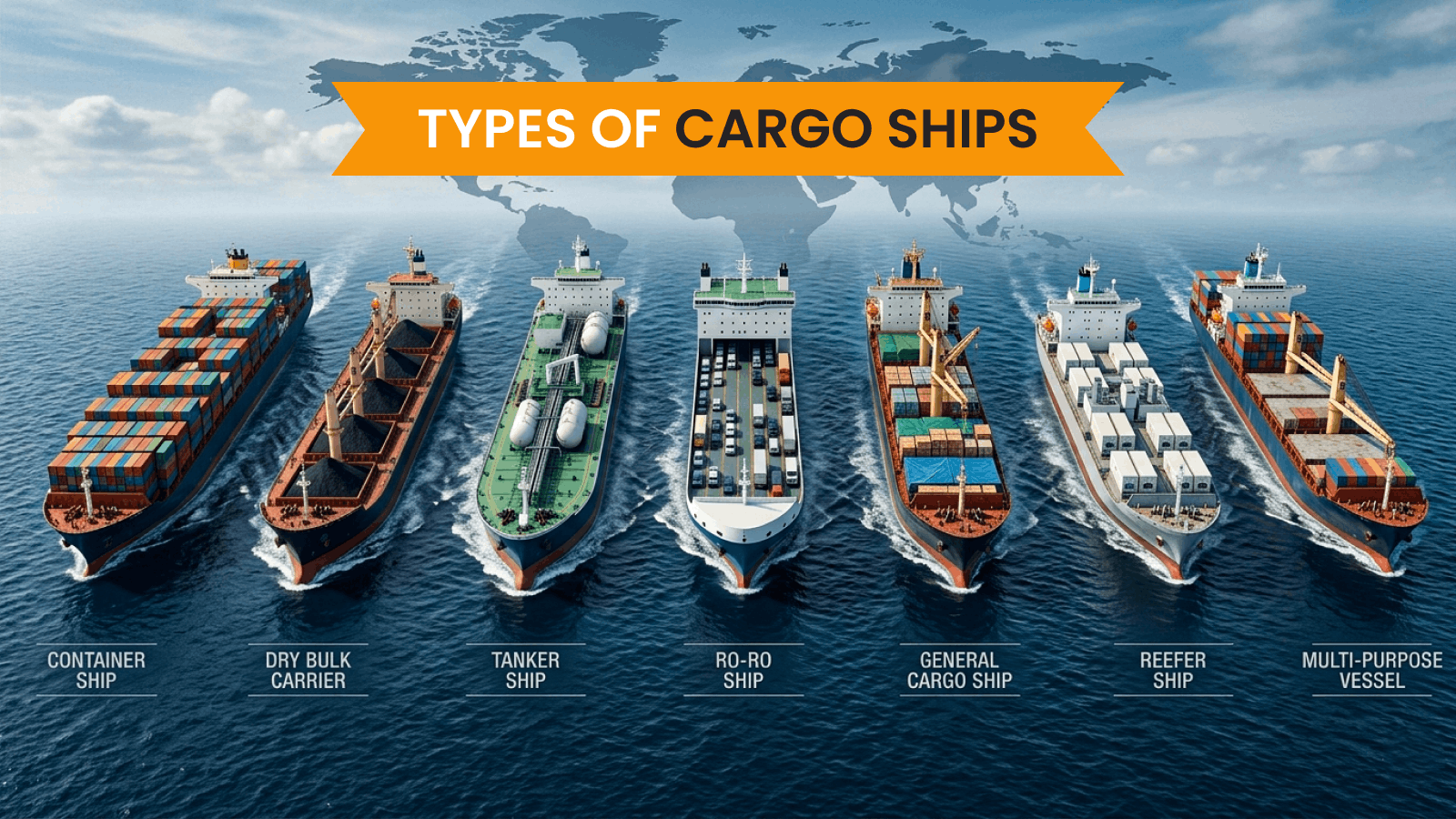
Every product you use daily has a journey behind it. From smartphones and cars to food and fuel, most goods travel thousands of miles before reaching the United States. The backbone of this global movement is ocean shipping. Businesses often rely on professional Ocean Freight Services to manage large scale international shipments efficiently.
Shipping cargo by sea is the most efficient and cost effective way to move goods at scale. But what many people do not realize is that there is not just one kind of cargo ship. There are multiple types of ship, each designed for a specific purpose.
Understanding the different types of cargo ships helps businesses make better logistics decisions, reduce costs, and improve delivery timelines.
In this guide, you will learn about each type of cargo ship in detail, how they work, and when to use them.
A cargo ship, also known as a freighter ship or cargo vessel ship, is a large commercial vessel designed to transport goods across oceans and waterways.
Unlike passenger ships, these vessels are built entirely for carrying cargo. They are engineered to handle different types of goods while maintaining stability, safety, and efficiency.
Key Characteristics of Cargo Ships
Cargo ships are designed with specific features that allow them to transport goods efficiently:
How Cargo Ships Support the USA Economy
The United States relies heavily on shipping cargo by sea for both imports and exports. Major ports like Los Angeles, Houston, and New York handle millions of tons of goods every year.
Without cargo ships, global trade would slow down significantly, increasing costs and limiting availability of goods.
To better understand common shipping language used in logistics, you can read our guides on Common Shipping Terms and Essential Logistics Terms.
Not all cargo is the same. Different goods require different handling, storage conditions, and transportation methods.
For example:
Because of these differences, the shipping industry developed multiple categories of ships to handle specific cargo types efficiently.
This quick comparison table helps you understand the different types of cargo ships, their uses, and where they fit in global shipping.
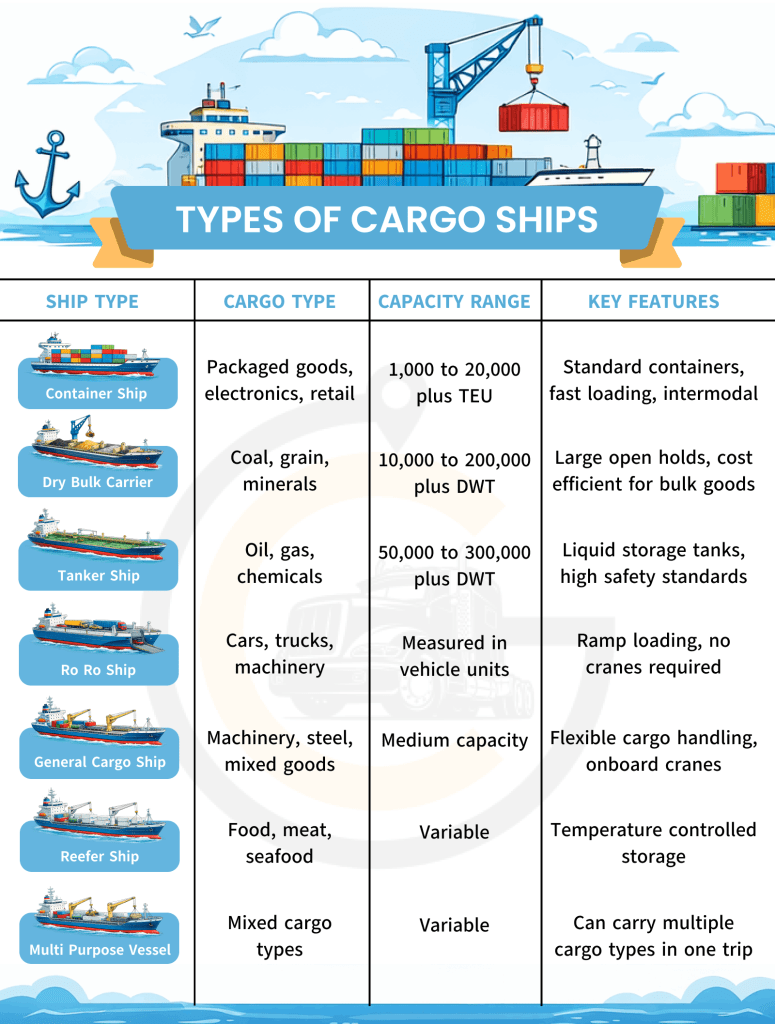
| Ship Type | Cargo Type | Capacity Range | Key Features |
| Container Ship | Packaged goods, electronics, retail | 1,000 to 20,000 plus TEU | Standard containers, fast loading, intermodal |
| Dry Bulk Carrier | Coal, grain, minerals | 10,000 to 200,000 plus DWT | Large open holds, cost efficient for bulk goods |
| Tanker Ship | Oil, gas, chemicals | 50,000 to 300,000 plus DWT | Liquid storage tanks, high safety standards |
| Ro Ro Ship | Cars, trucks, machinery | Measured in vehicle units | Ramp loading, no cranes required |
| General Cargo Ship | Machinery, steel, mixed goods | Medium capacity | Flexible cargo handling, onboard cranes |
| Reefer Ship | Food, meat, seafood | Variable | Temperature controlled storage |
| Multi Purpose Vessel | Mixed cargo types | Variable | Can carry multiple cargo types in one trip |
Container ships are the most widely used cargo ships in the world. They are designed to carry standardized containers, which makes loading and unloading fast and efficient.
How Container Ships Work
Goods are packed into metal containers, usually 20 foot or 40 foot units. These containers are stacked on the ship and secured for transport.
To understand the different container options used in shipping, read our detailed guide on Different Types of Shipping Containers.
Once they reach the port, cranes lift the containers and transfer them to trucks or trains.This process often involves Intermodal Freight and Drayage services to move cargo efficiently from ports to final destinations.
What They Carry
For shipments that require palletized handling, understanding Standard Pallet Size Dimensions can help optimize space and transport efficiency.
Importance in the USA
Container ships play a major role in US imports, especially from countries like China, Vietnam, and Germany.
Advantages
Dry bulk carriers are used to transport unpackaged goods in large quantities.
How They Work
These ships have large open cargo holds where materials are loaded directly without packaging.
What They Carry
Use Case in the USA
Bulk carriers are essential for exporting agricultural products from the Midwest and transporting raw materials for industries.
Advantages
After unloading at ports, cargo is typically transported inland using Full Truck Load Service or Flatbed Trucking depending on the shipment type.
Tanker ships are designed for transporting liquid cargo safely and efficiently.
Types of Tankers
How They Work
These ships have multiple sealed compartments that prevent mixing of liquids and ensure safe transport.
Role in the USA
The US energy sector relies heavily on tanker ships for importing and exporting oil and gas.
Advantages
Roll on roll off ships, also known as Ro Ro ships, are designed for vehicles and wheeled cargo.
How They Work
Vehicles are driven directly onto the ship using ramps and secured inside the vessel. These shipments often require Cross Border Logistics solutions for seamless international vehicle transportation.
What They Carry
USA Example
Imported cars from Japan and Europe often arrive at US ports using Ro Ro ships.
Advantages
General cargo ships are used for goods that do not fit into containers or require special handling.
What They Carry
When They Are Used
They are commonly used in smaller ports or regions where container infrastructure is limited.
Advantages
Refrigerated ships, also known as reefer ships, are designed to transport perishable goods.
How They Work
These ships maintain controlled temperature and humidity levels throughout the journey. For inland transportation, businesses rely on Reefer Services to maintain temperature control throughout the supply chain.
What They Carry
USA Use Case
Food imports such as seafood and fruits rely heavily on refrigerated shipping.
Advantages
Multi purpose vessels can carry different types of cargo in a single trip.
What They Carry
When They Are Used
These ships are ideal for routes where cargo demand varies or when transporting project based shipments.
Advantages
Liner Ships
These ships operate on fixed routes and schedules. They are commonly used in container shipping.
Tramp Ships
These ships do not follow a fixed schedule. They operate based on demand and are often used for bulk cargo.
Cargo ships are also classified by size, which determines where they can operate.
Common Categories
Understanding size categories is important for logistics planning in the USA.
Selecting the right cargo vessel ship depends on several factors.
Different goods require different ships. For example, liquids need tankers while bulk goods need bulk carriers.
Large quantities are best suited for bulk carriers or tankers, while smaller shipments may use container ships.
Not all ports can handle large ships. Smaller ports may require feeder vessels or general cargo ships.
Container ships are faster but may cost more, while bulk carriers are slower but more economical.
If you are looking to simplify logistics operations, our guide on Supply Chain Outsourcing explains how businesses can improve efficiency and reduce costs.
Container ships are the most commonly used because they can transport a wide range of goods efficiently.
The main categories include container ships, bulk carriers, tanker ships, Ro Ro ships, reefer ships, general cargo ships, and multi purpose vessels.
A freighter ship is another name for a cargo ship. Both terms are used interchangeably.
Ro Ro ships are specifically designed for transporting vehicles.
It is the most cost effective way to transport large volumes of goods across long distances.
Conclusion: The Future of Cargo Shipping
Cargo ships are the foundation of global trade and play a critical role in the US economy. Each type of cargo ship serves a unique purpose, ensuring that goods are transported safely and efficiently.
As global demand continues to grow, shipping technology is evolving with better fuel efficiency, automation, and sustainability practices.
For businesses, understanding the different types of ship is not just helpful but essential for making smart logistics decisions.




Comments are closed