
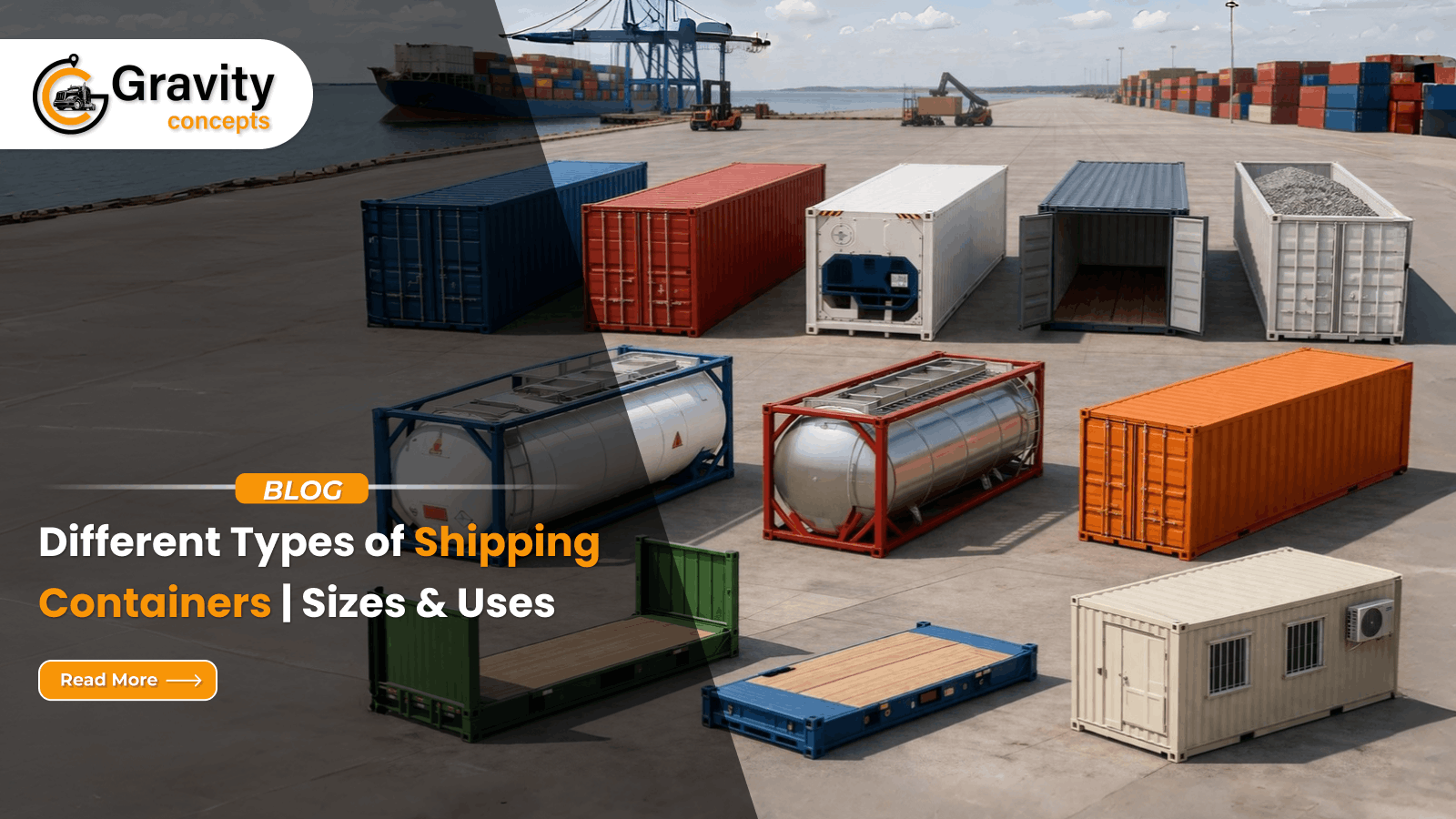
The Million-Dollar Mistake
It doesn’t start with a storm or a supply chain breakdown.
It starts with a simple decision — choosing the wrong container shipping solution or cargo containers.
Every year, U.S. businesses lose millions due to cargo damage, unexpected port delays, and rising detention and demurrage fees. A retailer ships temperature sensitive goods in a standard container. A machinery exporter underestimates cargo dimensions. An eCommerce brand overpays for unused space.
The result?
Damaged inventory. Missed deadlines. Profit margins are quietly eroding.
In today’s hyper-competitive global market, container selection is no longer a logistics detail — it’s a strategic decision.
The 2026 U.S. Logistics Landscape
The U.S. supply chain is evolving faster than ever.
From major ports like Los Angeles and Savannah to inland distribution hubs, businesses are adapting to:
In this environment, the right shipping container doesn’t just move goods —
it improves efficiency, reduces cost, and protects your brand reputation.
What You’ll Learn in This Guide
This is not another surface-level list.
Inside this guide, you’ll get:
Who This Guide is For
Whether you’re:
This guide is built to give you clarity, confidence, and a competitive edge.
Definition & Origin
A shipping container, also known as a freight container or ship container, is a standardized, reusable steel box designed to transport goods safely across long distances—by sea, rail, and road.
But the real breakthrough wasn’t the box itself.
It was standardization.
The modern shipping container follows specifications set by the International Organization for Standardization (ISO), ensuring that containers can be seamlessly handled anywhere in the world—regardless of the ship, port, or transport system involved.
Before containerization, cargo had to be manually loaded and unloaded piece by piece—a slow, expensive, and error-prone process. The introduction of ISO containers transformed global trade by:
Today, over 90% of global trade moves via shipping containers, making them the backbone of international commerce.
In the United States, shipping containers are the foundation of what’s known as the intermodal transportation system, a highly efficient network that moves goods using multiple modes of transport without ever unloading the cargo inside.
Think of it as a seamless journey:
These freight containers move seamlessly across ship, rail, and truck networks.
This system allows businesses to:
For U.S. importers, exporters, and eCommerce brands, containerization isn’t just logistics—it’s operational efficiency at scale.
Shipping containers are no longer just passive steel boxes.
Welcome to the era of Smart Containers.
Equipped with IoT (Internet of Things) sensors, these advanced containers provide real-time data on:
For industries like pharmaceuticals, food logistics and high-value cargo, this level of visibility is a game-changer.
In 2026, smart containers are helping U.S. businesses:
In short, shipping containers have evolved from simple storage units into intelligent assets powering the future of global trade.
Shipping containers are no longer just passive steel boxes.
Equipped with IoT (Internet of Things) sensors, smart containers provide real-time data on:
They help businesses prevent losses, optimize routes, and improve compliance—making them a key part of modern logistics.
Before exploring the types, it’s helpful to understand common logistics terms used in container shipping.
| Container Type | Standard U.S. Sizes | Best Use Case | IoT Capability |
| Dry Storage | 20ft, 40ft | General cargo | Yes |
| High Cube | 40ft HC | Bulky goods | Yes |
| Reefer | 20ft, 40ft | Perishables | Yes |
| Insulated | 20ft, 40ft | Temp-sensitive goods | Limited |
| Open Top | 20ft, 40ft | Machinery | No |
| Flat Rack | 20ft, 40ft | Heavy cargo | No |
| Open Side | 20ft, 40ft | Wide cargo | No |
| Double Door | 20ft, 40ft | Fast loading | Limited |
| Tank | 20ft | Liquids | Yes |
| Bulk | 20ft | Grains | No |
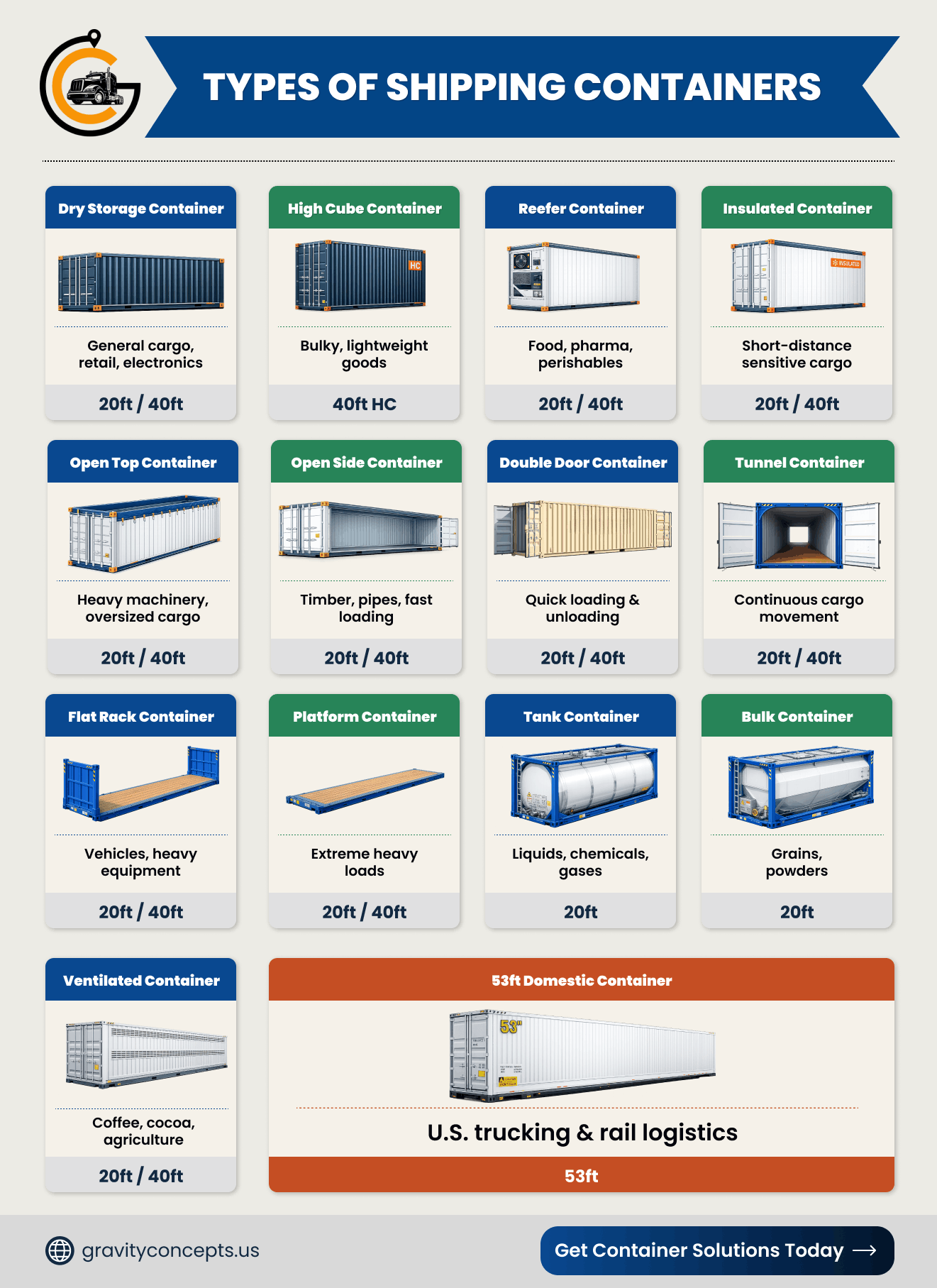
When it comes to everyday shipping in the U.S. and global trade, a few container types dominate the landscape. These are the workhorses of logistics—designed for efficiency, scalability, and versatility across industries.
If shipping containers had a default setting, this would be it.
The dry storage container—often called a standard container—is the most widely used type in global logistics. Built from durable steel and fully enclosed, it’s designed to transport a wide range of goods safely across long distances. Also known as shipping cargo containers, these are the most commonly used in global trade.
Standard Sizes:
Best Use Cases:
Why It Matters:
For most U.S. businesses entering international trade, this is the go-to starting point. It offers a balance of cost, availability, and flexibility—making it ideal for general cargo that doesn’t require special handling.
At first glance, it looks just like a standard container. But there’s one critical difference:
An extra 1 foot in height.
That small increase (typically 9.5 ft vs. 8.5 ft) makes a big impact—especially when you’re shipping high-volume, lightweight goods.
Standard Size:
Best For:
Why It Matters:
For U.S. importers dealing with volume-heavy cargo, High Cube containers help maximize space utilization—reducing the number of shipments needed and lowering overall freight costs.
While 20ft and 40ft containers dominate international shipping, the 53-foot container is the undisputed standard within the United States.
Designed specifically for domestic intermodal transport, these containers are larger, wider, and optimized for inland logistics.
Standard Size:
Where It’s Used:
Why It Matters:
The 53ft container is built to match U.S. highway regulations and rail infrastructure, allowing businesses to move more cargo per trip compared to international containers.
For companies operating within the U.S., this means:
In short, while ISO containers power global trade, the 53ft container powers America’s internal logistics engine.
In today’s U.S. supply chain, not all cargo can survive a standard container journey. From vaccines to fresh produce, certain goods demand precise temperature control and protection throughout transit.
This is where temperature-controlled containers become mission-critical—powering what’s known as the cold chain logistics network.
Reefer containers are the backbone of temperature-sensitive shipping.
Unlike standard containers, reefers are equipped with built-in refrigeration systems that actively regulate internal conditions—ensuring cargo remains within a strict temperature range from origin to destination.
Modern Technology (2026 Standard):
Best Use Cases:
Role in U.S. Cold Chain Logistics:
In the United States, reefer containers are a critical component of the cold chain ecosystem, a temperature-controlled supply chain that ensures product safety and compliance.
From farm exports in California to pharmaceutical shipments across states, reefers help:
For industries where even a small temperature fluctuation can mean millions in losses, reefer containers are not optional—they’re essential.
Not all temperature-sensitive shipments require active cooling.
Insulated (or thermal) containers are designed to maintain internal temperature without using powered refrigeration. Instead, they rely on high-quality insulation materials to slow down heat transfer.
Key Features:
Best Use Cases:
Why They Matter:
For U.S. businesses looking to balance cost and protection, insulated containers offer a practical middle ground—especially when full refrigeration isn’t necessary.
They are particularly useful in:
Not all cargo fits neatly through standard container doors. For oversized, awkwardly shaped, or high-frequency loading operations, open and high-access containers provide the flexibility that standard units simply can’t offer.
Not all cargo fits neatly through standard container doors. For oversized, awkwardly shaped, or high-frequency loading operations, open and high-access containers provide the flexibility that standard units simply can’t offer.
These containers are designed to solve one key problem:
How do you load and unload cargo efficiently when size, shape, or speed becomes a constraint?
When cargo is too tall or heavy to be loaded through traditional doors, the open top container becomes the ideal solution.
Instead of a fixed roof, this container features:
Loading Method:
Best Use Cases:
Why It Matters:
For U.S. industries like construction and manufacturing, open top containers make it possible to ship cargo that would otherwise be difficult—or impossible—to handle with standard containers.
When accessibility is the priority, open side containers deliver unmatched convenience.
These containers feature full-length side doors, allowing the entire side wall to open—transforming the container into a wide-access loading space.
Key Advantage:
Best Use Cases:
Why It Matters:
In fast-paced U.S. logistics environments—especially warehouses and distribution centers open side containers significantly reduce loading time and improve operational efficiency.
For operations that require continuous flow and efficient inventory handling, double door and tunnel containers offer a strategic advantage.
Design:
Key Benefit:
Best Use Cases:
Why It Matters:
FIFO is critical for industries dealing with:
With access from both ends, these containers help U.S. businesses:
When cargo goes beyond standard dimensions or requires strict handling conditions, specialized containers step in. These units are engineered for industries where size, weight, safety, and cargo behavior demand more than conventional solutions.
From oversized turbines to liquid chemicals and agricultural commodities, these containers support some of the most complex and high-value shipments in the U.S. and global supply chain. These are among the different types of containers used for oversized and industrial cargo.
For cargo that simply doesn’t fit inside a box, flat rack and platform containers provide an open, heavy-duty solution.
Structure:
Designed For:
Best Use Cases:
Why It Matters:
In industries like energy, construction, and infrastructure, these containers enable the transport of massive, irregularly shaped cargo that cannot be disassembled.
They are essential for project logistics where precision and load security are critical.
Transporting liquids and gases—especially hazardous ones—requires a completely different level of safety and compliance.
ISO tank containers are cylindrical tanks mounted within a steel frame, designed to safely carry both hazardous and non-hazardous liquids and gases.
Key Features:
Common Use Cases:
2026 Safety Standards & Certifications:
Why It Matters:
For U.S. chemical, food, and energy industries, ISO tanks ensure safe, compliant, and efficient transport—reducing risk while meeting strict regulatory requirements.
Some cargo doesn’t come in boxes—it flows, breathes, and reacts to its environment.
That’s where bulk and ventilated containers play a crucial role.
Bulk Containers
Designed for loose, unpackaged cargo, these containers allow goods to be loaded directly without individual packaging.
Best Use Cases:
Key Benefit:
Ventilated Containers
Certain cargo requires airflow to maintain quality during transit.
Ventilated containers are equipped with air vents that allow natural circulation, preventing moisture buildup and spoilage.
Best Use Cases:
Why It Matters:
For U.S. agricultural exporters and specialty goods suppliers, these containers help preserve product quality, flavor, and market value during long-distance shipping.
Shipping containers are no longer limited to moving cargo across oceans. In 2026, they’ve become a cornerstone of sustainable design, modular construction, and modern commercial spaces across the United States.
What was once an industrial asset is now being reimagined as a flexible, eco-friendly building solution.
At the heart of this transformation is sustainability.
Repurposed shipping containers are made from high-strength corten steel, and instead of being discarded after years of use, they are now being recycled into functional structures.
Key Sustainability Benefits:
In a market where U.S. businesses are under increasing pressure to meet ESG (Environmental, Social, Governance) goals, container-based construction offers a practical and scalable solution.
Modular construction is booming in the U.S. and shipping containers are leading the charge.
From urban office spaces to affordable housing projects, containers are being converted into fully functional, customizable living and working environments.
Common Applications:
Why the Surge?
In disaster-prone areas, container homes are also being used as rapid-response housing solutions, helping communities recover faster with durable, ready-to-deploy structures.
As consumer behavior shifts toward experiences, brands are rethinking how and where—they engage customers.
Enter the container-based retail revolution.
Shipping containers are now widely used to create:
Why U.S. Brands Love It:
In today’s “Experience Economy,” where customers value interaction as much as products, container retail spaces provide a creative, cost-effective way to stand out.
Choosing the right container isn’t just about type—it’s about precision. Dimensions, payload limits, and capacity directly impact cost, compliance, and cargo safety.
For U.S. logistics professionals, understanding these technical specifications is essential—especially when dealing with intermodal transport and road weight regulations.
| Specification | Measurement |
| External Length | 20 ft (6.06 m) |
| External Width | 8 ft (2.44 m) |
| External Height | 8 ft 6 in (2.59 m) |
| Internal Length | 19 ft 4 in (5.9 m) |
| Internal Width | 7 ft 8 in (2.35 m) |
| Internal Height | 7 ft 10 in (2.39 m) |
| Door Opening (W x H) | 7 ft 8 in × 7 ft 5 in |
| Cubic Capacity | ~1,172 cu ft (33.2 m³) |
| Max Payload | ~28,000 kg |
| Specification | Measurement |
| External Length | 40 ft (12.19 m) |
| External Width | 8 ft (2.44 m) |
| External Height | 8 ft 6 in (2.59 m) |
| Internal Length | 39 ft 5 in (12.03 m) |
| Internal Width | 7 ft 8 in (2.35 m) |
| Internal Height | 7 ft 10 in (2.39 m) |
| Door Opening (W x H) | 7 ft 8 in × 7 ft 5 in |
| Cubic Capacity | ~2,390 cu ft (67.7 m³) |
| Max Payload | ~26,500 kg |
| Specification | Measurement |
| External Height | 9 ft 6 in (2.89 m) |
| Internal Height | 8 ft 10 in (2.69 m) |
| Cubic Capacity | ~2,700 cu ft (76.4 m³) |
| Other Dimensions | Same as 40ft Standard |
Key Advantage:
~10–12% more volume compared to standard 40ft containers.
| Specification | Measurement |
| External Length | 53 ft (16.15 m) |
| External Width | 8 ft 6 in (2.6 m) |
| External Height | 9 ft 6 in |
| Internal Length | ~52 ft 6 in |
| Cubic Capacity | ~3,800–4,000 cu ft |
| Max Payload | ~29,000–30,000 kg |
Key Advantage:
Significantly higher volume → optimized for U.S. domestic freight efficiency
Container capacity isn’t just about space—it’s also about legal weight limits.
In the United States, cargo movement via road must comply with the Federal Bridge Gross Weight Formula, which determines how much weight a truck can legally carry based on axle spacing.
Why It Matters:
| Container Type | Best For | Key Advantage |
| 20ft | Heavy cargo (dense goods) | Higher weight capacity per volume |
| 40ft | Standard shipments | Balanced cost and capacity |
| 40ft HC | Bulky, lightweight goods | Extra height → more volume |
| 53ft (U.S.) | Domestic transport | Maximum capacity for inland logistics |
Key Takeaway
The right container size is a balance between:
For U.S. businesses, optimizing this balance can mean the difference between profitable shipping and unnecessary costs.
Selecting the right shipping container isn’t guesswork—it’s a strategic decision framework. For U.S. businesses, the right choice depends on aligning your cargo type, route conditions, compliance requirements, and technology needs.
Use this checklist to make a confident, cost-effective decision every time.
Start with the most important question:
What exactly are you shipping?
Your product’s physical and chemical characteristics determine the container type.
Key Factors to Evaluate:
Pro Tip:
Choosing based on price alone often leads to damage costs that far exceed savings.
A container doesn’t just sit—it travels across multiple environments.
Ask Yourself:
Why It Matters:
In U.S. ports and global shipping, compliance is non-negotiable.
One of the most critical requirements is SOLAS (Safety of Life at Sea) / VGM (Verified Gross Mass).
What It Means:
Why It Matters:
U.S. Relevance:
Strict enforcement at major ports means compliance directly impacts delivery timelines and costs.
In 2026, visibility is a competitive advantage.
Ask yourself:
Do you need real-time tracking and condition monitoring?
Consider IoT-Enabled Containers If You’re Shipping:
What Smart Containers Offer:
Why It Matters:
Instead of reacting to damage after delivery, you can prevent losses before they happen.
Even experienced shippers can fall into costly traps when selecting and managing shipping containers. In the U.S. logistics environment—where margins are tight and delays are expensive—these mistakes can quickly turn into serious financial losses.
Avoiding the following pitfalls can save your business time, money and operational headaches.
One of the most overlooked expenses in container shipping is drayage—the cost of transporting a container from the port to a nearby warehouse, rail yard, or distribution center.
Why It’s a Problem:
U.S. Reality (2026):
With congestion at major ports like Los Angeles and Savannah, drayage costs have become a major factor in total shipping expenses.
How to Avoid It:
It’s one of the most underestimated risks in shipping—yet one of the most damaging.
“Container rain” occurs when temperature differences between the inside and outside of the container cause condensation to form on the سق of the container, eventually dripping onto the cargo.
What Causes It:
At-Risk Cargo:
Impact:
How to Avoid It:
Not all containers are created equal and choosing the wrong grade can lead to compliance issues or cargo damage.
Two Common Grades:
Cargo Worthy (CW):
Wind & Watertight (WWT):
Why It’s a Problem:
How to Avoid It:
In 2026, shipping container costs in the United States are shaped by a mix of global supply-demand dynamics, domestic logistics pressures, and evolving leasing models.
For businesses, understanding these cost structures is key to making profitable shipping decisions—not just operational ones.
When purchasing containers, U.S. buyers typically choose between one-trip (new) and used containers each with distinct cost and use-case advantages.
These containers have made only a single journey (usually from Asia to the U.S.) and are considered “like new.”
2026 Price Range (U.S.):
Best For:
Previously used containers are more affordable but vary in condition.
2026 Price Range (U.S.):
Best For:
For many U.S. companies, leasing containers is a smarter financial move—especially when dealing with short-term demand or fluctuating shipping volumes.
Short-Term Leasing
Long-Term Leasing
One of the most strategic options in 2026 logistics.
How It Works:
Why It’s Powerful:
Container pricing doesn’t exist in isolation—it’s directly influenced by broader logistics trends.
Fuel Surcharges
Fuel remains one of the biggest cost drivers in transportation.
Impact:
Major U.S. ports are undergoing modernization—but not without added costs.
Key Factors:
2026 Reality:
Ports like Los Angeles, Long Beach, and New York are balancing efficiency upgrades with rising operational costs—which ultimately impact container pricing.
Key Takeaway
In 2026, container cost optimization is about more than just price—it’s about choosing the right ownership model, timing, and logistics strategy.
Businesses that understand these dynamics can:
Shipping containers are not just logistics tools, they are industry enablers. Across the United States, different sectors rely on specific container types to solve unique operational challenges, improve efficiency, and protect high-value goods.
Here’s how containers are used in real-world scenarios:
In the fast-paced world of U.S. eCommerce, speed is everything.
To meet rising customer expectations for same-day and next-day delivery, companies rely heavily on 53ft domestic containers for inland transportation.
How They’re Used:
Why It Works:
For eCommerce giants and growing brands alike, 53ft containers are the backbone of rapid fulfillment networks.
The United States is one of the world’s largest exporters of agricultural products—and shipping containers play a key role in that supply chain.
Bulk containers are widely used to transport:
How They’re Used:
Why It Works:
For U.S. farmers and exporters, bulk containers help deliver products to global markets cost-effectively and at scale.
In healthcare and pharmaceuticals, there is zero margin for error.
Products like vaccines, biologics, and medical supplies require strict temperature control and real-time monitoring—making smart refrigerated (reefer) containers essential.
How They’re Used:
Why It Works:
In 2026, smart reefers are not just containers, they are critical healthcare infrastructure.
Construction sites demand flexibility, security, and durability—and shipping containers deliver all three.
Common Uses:
Why It Works:
For U.S. construction companies, containers provide a practical, scalable solution for managing on-site operations.
Key Takeaway
Across industries, the right container doesn’t just move goods—it enables business performance.
From faster deliveries to safer medical transport and cost-efficient exports, shipping containers are deeply integrated into how modern U.S. industries operate.
The most common shipping containers in the U.S. are 20ft and 40ft standard (dry storage) containers for international trade. However, for domestic transportation, the 53ft container is the most widely used due to its higher capacity and compatibility with U.S. rail and trucking systems.
A shipping container typically lasts 20–25 years in active shipping use, depending on maintenance and environmental conditions. After that, many containers continue to be used for storage or modified applications, extending their total lifespan to 30+ years.
A Smart Container is a shipping container equipped with IoT (Internet of Things) sensors that provide real-time data on location, temperature, humidity, and cargo conditions. These containers help businesses monitor shipments, prevent damage, and improve supply chain visibility.
Yes, 40ft containers can be used for domestic U.S. rail transport, especially in intermodal shipping. However, most domestic rail and trucking networks prefer 53ft containers because they maximize cargo capacity and are optimized for U.S. infrastructure and cost efficiency.
In today’s fast-evolving U.S. logistics landscape, a shipping container is far more than a steel box.
It’s a strategic asset that directly impacts your costs, efficiency, and customer satisfaction.
From choosing between a 20ft or 53ft unit to deciding on smart tracking or temperature control, every decision you make influences:
The difference between smooth operations and costly disruptions often comes down to one simple choice selecting the right container.


Comments are closed