
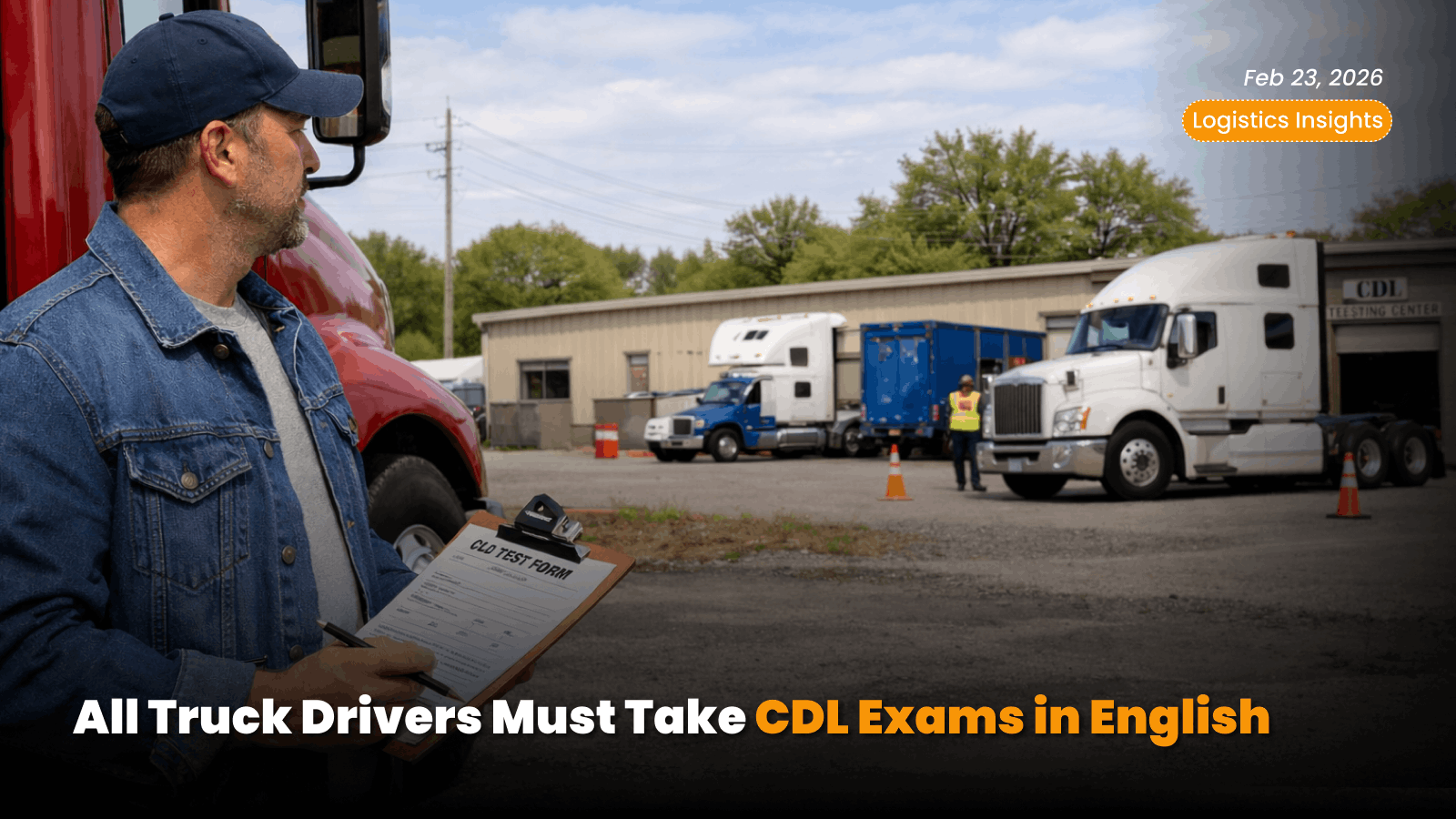
The U.S. Department of Transportation (DOT) has announced that all commercial truck and bus drivers will now be required to take their Commercial Driver’s License (CDL) exams in English. The change is part of a broader safety initiative aimed at improving road safety standards and removing unqualified drivers from operating commercial vehicles.
Transportation Secretary Sean Duffy made the announcement on February 20, stating that commercial drivers must be able to understand English well enough to read road signs and communicate effectively with law enforcement officers.
Although federal rules already require CDL holders to demonstrate English proficiency, several states have allowed applicants to take their CDL exams in other languages. Under the updated safety measures, this practice will be restricted to ensure uniform compliance. Florida has already begun administering CDL tests exclusively in English.
The administration’s safety campaign is also expanding to address fraudulent trucking companies and questionable CDL training schools. Officials are working to prevent unsafe or non-compliant carriers from entering the industry and to ensure that states strictly follow federal licensing regulations.
Earlier this week, the Transportation Department stated that 557 driving schools should be shut down because they failed to meet basic safety standards. The department has also intensified enforcement efforts after discovering that certain states issued CDLs to individuals who did not qualify under federal rules.
The renewed focus on enforcement follows several fatal crashes. In August, a truck driver who, according to Secretary Duffy, was not authorized to be in the United States made an illegal U-turn in Florida, resulting in a crash that killed three people.
Additional deadly crashes, including one in Indiana earlier this month that resulted in four fatalities, have further increased concerns about driver qualification and regulatory oversight.
Secretary Duffy stated that the trucking company registration system and related requirements will be strengthened. Federal Motor Carrier Safety Administration (FMCSA) inspectors will conduct additional spot checks of trucks and CDL training schools.
Currently, trucking companies can register to operate by paying a relatively small fee and providing proof of insurance. In many cases, they may not face an audit for a year or longer. Officials say this has allowed certain fraudulent operators — commonly referred to as “chameleon carriers” — to repeatedly register under different business names to avoid penalties after crashes or violations.
Authorities are also reviewing electronic logging devices (ELDs) used by drivers to ensure accuracy and compliance. At the same time, the department is working to confirm that states are fully following federal regulations when issuing commercial driver’s licenses.
The new English-language CDL testing requirement, along with stronger oversight of schools, states, and trucking companies, reflects the administration’s broader effort to enhance safety across the commercial transportation industry. Officials say the goal is to close regulatory gaps, prevent fraud, and ensure that only qualified drivers are operating on U.S. highways.



Comments are closed